Why Soap Bubbles Flash with Changing Colors
Why soap bubbles flash with changing colors comes down to light meeting a shifting film. Learn how thickness and viewing angle shape the hues you see.
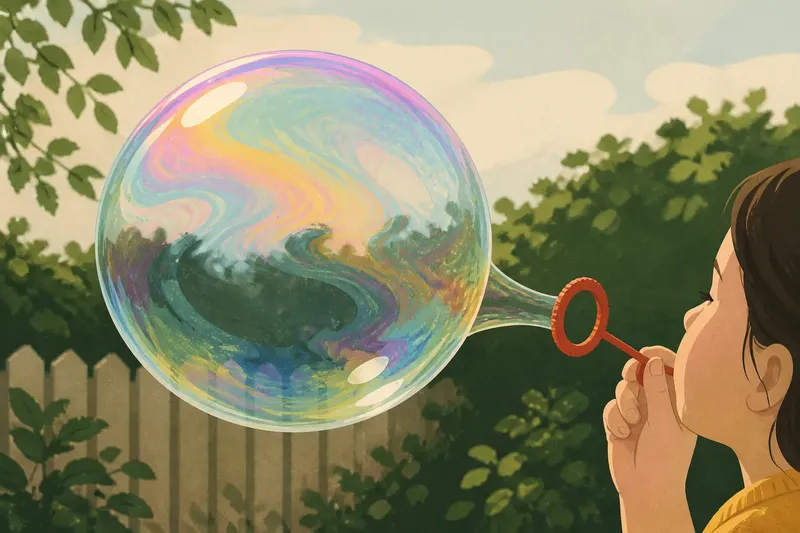
The common mistake is to think a soap bubble is painted with a rainbow. Why soap bubbles flash with changing colors comes down to reflected light waves meeting across a film so thin that they can reinforce or cancel one another. As the bubble moves, its colors shift, fade, or appear in new places.
Two reflections create a soap bubble’s colors
A bubble is a thin sheet of soapy water, with air on both sides. When light strikes it, some reflects from the film’s outer surface. The rest enters the film, reflects from its inner surface, and travels back out. Those reflected portions can then overlap.
Light behaves as a wave, and each color corresponds to a different wavelength. When waves of the same color arrive in step, their peaks and troughs align, strengthening that color in the reflected light. When they arrive out of step, a peak can meet a trough, weakening or canceling it.
White light contains many colors. A bubble’s surface can therefore strengthen some wavelengths while reducing others. The mixture that reaches your eye is perceived as a particular color.
This effect is called thin-film interference. It also creates colors on a thin layer of oil on water. A bubble makes the effect especially lively because its film is curved, moving, and continually changing thickness.
Film thickness changes which colors are reflected
The distance light travels inside the film affects when the inner reflection meets the outer one. A thicker patch adds more travel; a thinner patch adds less. That changes the relative timing of the waves, shifting which wavelengths reinforce and which are weakened.
The optical path is not the only factor. A wave also changes phase when it reflects from a boundary. At the boundary from air into the water-based film, the reflected wave reverses phase. This helps explain why an extremely thin patch can reflect very little visible light instead of displaying a strong color.
As the film thins, a wavelength that was once strongly reflected may become faint, while another grows more visible. The colors are not painted bands attached to the bubble; they are the changing result of several wavelengths interacting.
A pale or nearly black patch has not necessarily lost all its color-producing material. Its thickness may cause much of the visible light to cancel in reflection, leaving little for the eye to see.
Gravity and drainage keep the color pattern moving
Liquid drains down the bubble’s curved surface under gravity. The film may become thinner near the top while thicker liquid gathers lower down, though airflow and the bubble’s shape can complicate the pattern. As thickness changes across the surface, the reflected colors shift too.
A bubble also stretches and quivers. A breath, a slight breeze, or a moving wand can reshape the film and alter its thickness. Even when the bubble seems still, small changes can move a color boundary or make a bright patch flicker.
Imagine a bubble floating in a sheltered corner of a yard. Its upper area gradually drains thinner, and a faint band of color creeps across the curve. A light breeze nudges the bubble; the film flexes, the band shifts, and the visible result is a moving pattern rather than a new layer of pigment.
Drainage can eventually leave a region so thin that its visible reflections become very weak. A dark patch may appear before the film breaks. It signals a change in reflected light, not an exact countdown to the pop.
Viewing angle changes the reflected colors
Look at a bubble from different positions and its colors can change even if the film has not visibly moved. Light entering the film at an angle travels along a different path than light arriving more directly. That changes the interference conditions, so a wavelength bright from one viewpoint may look weaker from another.
The light source matters too. A bright overcast sky illuminates the bubble from many directions. A small, distinct source creates a different arrangement of reflections and highlights. The observed color depends on the light reaching the bubble and the direction from which it reaches your eye.
For a simple observation, hold a bubble wand near a bright window or outdoors under a bright sky. Keep a relatively dark background, then shift your head slightly rather than moving the bubble. Notice whether a patch changes hue or brightness. The shift shows how reflection and viewing geometry work together.
Why do bubbles show bands, shimmer, or turn dark?
Why do rainbow-like bands appear?
Different parts of the curved film have different thicknesses, so they favor different wavelengths. The gradual change from one thickness to another can create neighboring bands of color rather than a single uniform shade.
Why do the colors move when a bubble seems still?
Gravity continues to draw liquid through the film, and tiny air currents can flex it. Either change can alter thickness or the angle of reflection enough to shift the pattern.
Why can a bubble look black?
Some very thin regions reflect little visible light because the reflected waves cancel across much of the spectrum. Against a brighter background, that weak reflection can look nearly black.
Does a bubble show every rainbow color at once?
White light offers many wavelengths, but a particular patch and viewing angle may strengthen only some of them. Other wavelengths can be faint or canceled, so the colors vary across the surface instead of forming a complete, fixed rainbow everywhere.
What should you watch to see the colors change?
- Check the light source. If the bubble is dimly lit, then move it near daylight or a bright lamp; if the light is already bright, keep it and adjust your viewing angle instead.
- Check the background. If a bright background washes out subtle patches, then view the bubble against a darker area; if the background is already dark, keep it and look for faint color bands.
- Check your viewpoint. If one position shows little color, then shift your head slightly; if the colors are already clear, hold still and watch for changes in hue or brightness.
- Check different parts of the surface. If the upper area looks thinner or darker than the lower area, then compare their colors; if thickness is hard to judge, scan across the whole bubble and look for changing bands.
- Check for movement. If a breeze or draining film shifts the pattern, then watch how the colors move; if the bubble is steady, keep observing rather than treating a dark patch as an exact sign that it will pop.
- Check whether the bubble is visible at all. If reflections are too faint to distinguish, then change the background or light source; if they are visible, keep the setup steady while changing only your viewpoint.
Why soap bubbles flash with changing colors is ultimately a question of timing: reflected light waves travel different paths, and a moving film keeps changing how they meet. Watch a color patch as you shift your head or as the bubble moves. That small change makes the film’s otherwise invisible thinness visible.