The Folk Etymology Trap: When a Neat Word Story Misleads
Folk etymology can make a word’s origin sound obvious. Learn which clues deserve trust and how to decide when a satisfying story needs better evidence.
The most common mistake with folk etymology is treating a tidy story as proof: a familiar word seems to contain a phrase, so the phrase must explain its origin. That shortcut can turn an amusing guess into a false history, and it can make genuine word histories harder to recognize. A better approach is to ask what kind of claim you have encountered and what evidence would fit it.
Folk etymology begins with a tempting resemblance
Folk etymology is the reshaping or reinterpretation of an unfamiliar word through familiar sounds or words. It can describe a real change in how people use a word. It can also name a mistaken explanation that merely makes the word seem less mysterious.
Those are different claims. A word may genuinely have changed form because speakers connected it with a familiar expression. But a story that spots a resemblance in a word’s spelling has not, by itself, shown that speakers made that connection or that it shaped the word’s history.
The trap is especially attractive when an explanation is vivid, memorable, or morally satisfying. A story that turns a word into a miniature lesson can travel farther than a cautious account of uncertain origins. A good story may be worth repeating as folklore; it should not be presented as established etymology without evidence.
Choose your next move by the claim you have heard
Different word-origin claims call for different checks. Start by identifying whether the story is about a sound, a spelling, a change in meaning, or an event said to have created the word.
- If the story depends on a visual split: Treat it as a guess until you can trace the word’s earlier forms. A modern spelling can invite a clever pun long after the word entered the language.
- If it describes a change in pronunciation or form: Look for evidence that the altered form occurred in use, rather than assuming that two similar-sounding words must be related.
- If it claims a phrase or slogan created the word: Ask whether the word appears earlier than the phrase. Earlier records would weaken that origin claim, though they would not automatically explain every later change.
- If it names a particular person, place, or incident: Look for dated evidence linking that event to the word. A colorful anecdote without a traceable connection is not enough.
- If the source admits uncertainty: Keep that uncertainty. An origin can remain disputed or unknown; replacing the gap with a confident tale does not solve it.
This decision guide is not a demand to investigate every casual conversation. It helps you choose how strongly to repeat a claim: as a documented history, a possible explanation, or simply a story people tell.
Check the word’s trail before trusting its parts
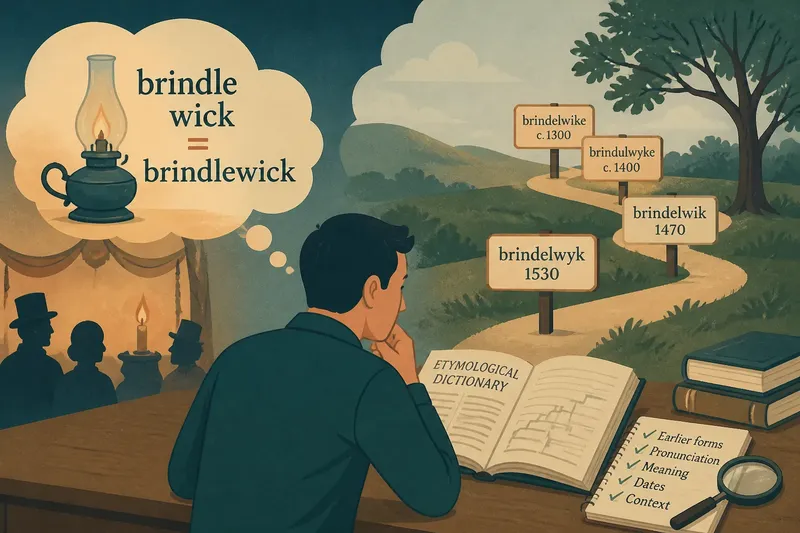
A useful etymology gives a word a trail through time. It may compare older spellings, pronunciations, and meanings, then explain how one form could plausibly lead to another. A neat modern decomposition skips that trail and treats today’s letters as if they were the word’s original building blocks.
For a first check, consult a reputable etymological dictionary rather than relying only on a general dictionary’s brief definition. Compare entries in more than one reference if the proposed origin sounds unusually dramatic. Look for dated citations, earlier forms, and a clear distinction between what is known and what remains uncertain.
Dates in an entry usually show that a form is attested by that point, not necessarily that it was invented then. Likewise, a similar-looking word in another language is a lead to examine, not proof of borrowing. The proposed path needs to account for the forms, meanings, and languages involved.
Say you hear an invented story that the word “brindlewick” came from “brindle wick,” supposedly the name of a lamp used in an old ceremony. The spelling may make the tale feel plausible. If an etymological reference instead records earlier forms with a different sound and no connection to a lamp, you have a concrete reason to withhold belief and describe the lamp story as unverified.
Separate real reshaping from a made-up origin
Some folk explanations do leave fingerprints in a word’s form. Speakers can adapt an unfamiliar word to resemble a familiar one, especially when the original form is hard to parse. In those cases, historical evidence may show earlier versions alongside a later form that fits the new association. The explanation concerns a change in transmission, not simply a clever way to divide the present-day spelling.
By contrast, an origin story can be false even if its proposed phrase resembles the word closely. Sound-alikes arise by chance, and spelling can change for reasons unrelated to the story. To assess the claim, ask whether the proposed explanation accounts for earlier evidence and whether the suggested change is linguistically plausible.
Meaning matters, too. A story may connect a word to an activity or custom that seems like a perfect fit, but a matching meaning does not establish a historical link. A credible account should explain how the word’s recorded meanings developed, not just point to one convenient overlap.
Which clues should change your confidence?
Does a familiar phrase prove where a word came from?
No. A phrase may resemble a word because of coincidence, later wordplay, or a genuine connection that still needs evidence. Check older forms and dated usage before treating the phrase as an origin.
What evidence makes an origin story stronger?
A traceable sequence of forms, pronunciations, and meanings is more useful than a clever match to modern spelling. Historical dictionaries and dated quotations can help establish when a form was in use and whether the proposed path makes sense.
Can folk etymology describe a real change?
Yes. Speakers sometimes reshape an unfamiliar form under the influence of a familiar word or phrase. The claim is stronger when the change appears in evidence, rather than being inferred solely from how the current word looks.
What should you say when experts disagree?
Describe the origin as disputed, uncertain, or unknown, depending on the references you consult. Avoid turning one proposed account into a settled fact just because it makes the best story.
Repeat the story at the confidence it deserves
When you share an origin, make its status part of the sentence. “The word is traced to…” suits a well-supported account; “one proposed origin is…” leaves room for uncertainty; “people sometimes say…” signals a circulating tale rather than a verified history. That small distinction keeps curiosity intact without overstating what the evidence can show.
The folk etymology trap is not enjoying a clever word story. It is mistaking the pleasure of a satisfying explanation for the work of establishing a word’s past. When a story fits the spelling too perfectly, check the word’s trail first—and let the evidence, not the punchline, set your confidence.