How a Door Hinge Lets a Door Move
Learn how a door hinge’s pivot and placement guide a door’s swing, explain its gaps, and help you tell a hinge problem from a latch or track issue.
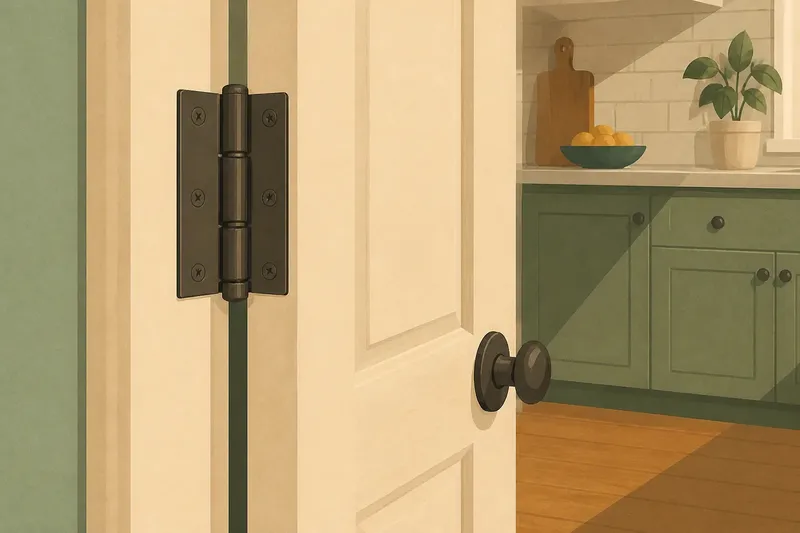
The common mistake with a door hinge is to treat it as a simple connector. A door hinge also sets the pivot that guides the panel’s swing, shaping its path past the frame and the gaps around it.
A door hinge turns a fixed joint into a moving one
Open a familiar room door slowly and watch the narrow gap at the hinge side. The door does not slide away from the frame. It rotates around a line formed by the hinge pins, while the hinge leaves remain attached to the door and frame. That line is the pivot, or axis of rotation.
A typical butt hinge has two flat leaves joined by curled knuckles. Their interlocking curls form a barrel around a pin. One leaf is fastened to the door edge; the other is fastened to the frame. The pin holds the leaves together and lets them turn relative to each other.
The leaves carry the connection; the pin provides the turning axis. Without a pivot, the fastening would hold the panels rigidly. Without leaves secured to the panels, the pivot would not guide the door.
As the door moves, the pivot stays in place. Each point on the panel swings along an arc around that axis. The outer edge travels farther than the edge near the hinges, so the handle makes a broad sweep while the hinge-side gap changes little.
Hinge placement shapes the swing and the gaps
A hinge is often set into shallow recesses in the door edge and frame. These recesses, called mortises, let the leaves sit close to flush with the surrounding surfaces. If a leaf stands proud, the door may sit differently against the frame or resist closing. The position of each mortise also fixes where the pivot sits.
Look at a closed interior door from above, if you can do so without forcing it. The hinge barrel sits near the edge, not at the center of the door’s width. That offset gives the panel clearance to rotate past the frame. The door and frame need room for the sweep, especially near the hinge side and top corner.
In a simple drawing, move the hinge outward and the pivot shifts away from the door edge. The door’s path changes, and its edge may meet the frame differently. Hinge position is part of the door’s working geometry, not just a decorative choice.
Ordinary doors often have hinges arranged vertically, with one near the top and another near the bottom; some designs use more. Their placement helps connect the door along its height. The right arrangement depends on the door and hardware. If a door sags, binds, or leaves an uneven gap, the cause may not be obvious from a glance. Follow the manufacturer’s directions for repairs, and consult a qualified carpenter if the cause is unclear.
Hinge designs guide motion in different ways
The butt hinge is familiar on many room doors: its leaves meet at the door edge and frame, and its pin is visible in a narrow vertical barrel. Some versions allow the pin to be removed; others keep it in place. In either case, two fixed leaves turn around a shared axis.
A concealed hinge hides much of its mechanism when a cabinet or door is closed. On many kitchen cabinets, one part sits in a round recess in the door and another attaches inside the cabinet. Linked arms guide the opening. The pivot is not an exposed barrel, but the door still follows a controlled path.
A pivot hinge supports a door at points near its top and bottom instead of with side-mounted barrels. Depending on the design, the door can appear to turn around a more central line. The contrast shows that a hinge is defined by the motion it permits, not by one familiar shape.
Spring hinges include a mechanism that urges a door toward a resting position. Continuous hinges extend along much of a door’s height. These features change how the door is supported or behaves, but the useful question remains: where is the pivot, and which parts stay fixed as the door moves?
What can a moving door tell you?
Why does the handle travel farther than the hinge edge?
The handle sits far from the pivot, so it traces a larger arc as the door turns. Points close to the hinge axis follow smaller arcs during the same motion. That difference makes a small push at the handle easy to see across the panel.
Why does a door need a gap beside its frame?
The edge sweeps through space as the door rotates, so it needs clearance to pass the frame without scraping. The shape of the gap can show whether the door sits evenly, but the gap alone does not identify the cause of a problem.
Why do some doors have more than two hinges?
Additional hinges connect the door at more points along its height and may suit a design that calls for extra support or a particular movement. The number and placement depend on the door and hardware, so hinge count alone does not show how a specific door should be installed.
Can a hinge change which way a door opens?
The hinge side and pivot position help determine the direction and arc of the swing. The frame, surrounding space, and hinge type matter too. Check a door’s intended handing before choosing replacement hardware.
How can you read a door’s movement?
- Check whether the panel rotates around a fixed hinge barrel. If it does, then follow the barrel as the pivot; if it does not, look for a track or another support instead.
- Check which side of the panel carries the hinge leaves. If they are on the left, then observe the swing from that side; if they are on the right, observe from the opposite side before describing the door’s handing.
- Check whether the hinge leaves sit close to flush in their mortises. If they do, then note that the recesses accommodate the hardware; if a leaf stands proud, avoid forcing the door and ask a carpenter to assess the fit.
- Check whether the door edge clears the frame as it swings. If it clears, then the gap is serving its purpose; if it scrapes, note the contact point and consult the manufacturer’s repair instructions or a qualified professional.
- Check whether the door slides along a visible track instead of rotating at a side pivot. If it slides, then follow the track to understand its path; if it rotates, trace the swing back to the hinge axis.
- Check whether the door catches, drifts, or scrapes near the floor. If you notice one of these signs, record where it occurs and seek qualified help if the cause is unclear; if the movement is smooth, simply observe how the handle’s arc compares with the hinge edge.
Say you are looking at a pantry door that swings into a kitchen. In this invented situation, the starting point is a closed door with a visible barrel on its left side, a handle on the outer edge, and no track along the floor. First, you identify the barrel as the likely pivot and gently open the door without forcing it. Next, you watch the outer corner sweep through the kitchen while the hinge edge turns close to the frame. The result is a clear description: the leaves stay attached, the pin line remains the axis, and the panel rotates rather than slides. If the edge scrapes, the observation changes the next decision: stop treating the movement as ordinary and ask a qualified professional to assess the fit.
A latch holds a door closed; a hinge guides its rotation. A sliding door follows a track instead, with no side-mounted pivot directing its path. Noticing which action you see helps describe the hardware without confusing its jobs.
When a door feels awkward, note where resistance occurs. A scrape near the floor differs from a stiff turn at the hinge side, and a door that drifts open behaves differently from one that catches against the frame. These observations describe the motion, not a certain cause, but they give a repair professional a clearer starting point than “the door is broken.”
Next time a door swings, follow the handle with your eyes, then look back to the hinge barrel. The handle makes the motion visible; the pivot explains how the panel moves without coming loose. A door hinge is small, but its placement maps the door’s path.