Choose the Right Word by Checking Its Meaning First
A dictionary or thesaurus can help you choose the right word, but checking the definition first keeps a near-synonym from changing your meaning.
The most common mistake with a dictionary or thesaurus is opening the thesaurus first, spotting a word that sounds sharper, and swapping it in before checking what it means. The cost is a sentence that sounds polished but says something different from what you intended. Start with the meaning you need; only then look for another word.
Write down what the word must mean
Before reaching for a book or app, read the sentence around the word. Ask what job the word is doing and what facts it needs to preserve. Is it describing a physical action, a person’s attitude, a degree of certainty, or a relationship between ideas?
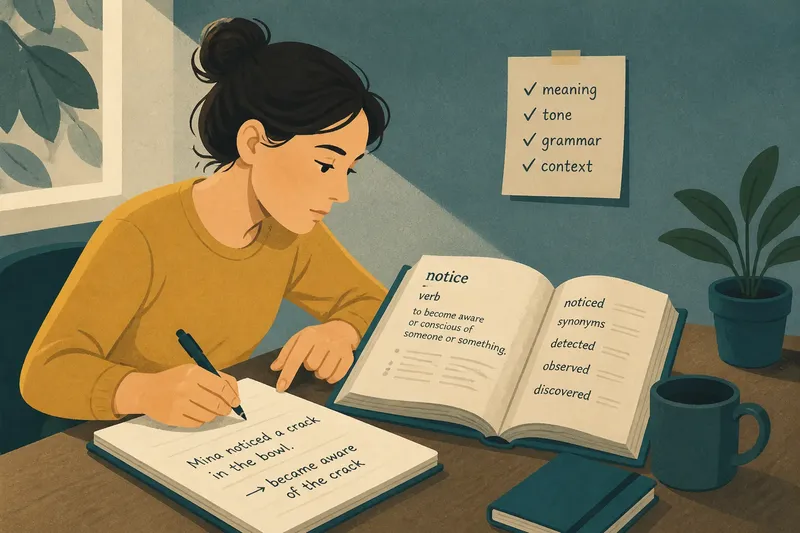
Take the sentence “Mina noticed a crack in the bowl.” The verb noticed says that the crack entered her awareness. It does not say she examined it closely, understood its cause, or deliberately searched for it. That small distinction is the standard any replacement must meet.
For a quick check, make a plain-language note beside the sentence: “became aware of the crack.” This is not a substitute for a definition. It is a reminder of the meaning you want to keep while comparing choices.
Use a dictionary to pin down the sense
A dictionary is designed to explain a word’s meaning. Look up the word as it appears in your sentence, then read the definitions rather than stopping at the first bold entry. Many familiar words have several senses. The relevant one is the sense that fits the sentence’s subject and surrounding details.
Check the part of speech, too. A noun, verb, and adjective can look alike while behaving differently. The dictionary may also give example sentences, usage labels, or information about whether a word is formal, informal, technical, or regional. Those details help you decide whether the entry belongs in your sentence, not merely whether it resembles your intended idea.
Suppose you want to replace bright in “The bright student answered quickly.” A dictionary can help distinguish intellectual sharpness from strong light or vivid color. A thesaurus may offer several nearby words, but the definition tells you which sense of bright is active here.
Read the thesaurus entry as a set of candidates
A thesaurus gathers related words, often under a shared sense. It is useful for generating options when a word feels repetitive, flat, or poorly fitted to the tone. It does not, by itself, establish that every listed option can replace the original in every sentence.
Read the heading or sense label above the list. Then treat each suggestion as a candidate, not an answer. A synonym can overlap with the original while adding a stronger emotion, a narrower meaning, or a different level of formality. Some thesauruses also group antonyms nearby, so check whether a label marks them as opposites.
Imagine you are revising “The manager noticed the error.” You want a more precise verb, not a more dramatic one. The thesaurus offers detected, observed, and discovered. If the manager deliberately searched for a fault, detected may fit; if the error simply caught her eye, the original may be more accurate. Check the dictionary entry and reread the whole sentence before deciding.
Compare candidates inside the original sentence
Once you have a short list, place each option into the sentence. Listen for changes in meaning, tone, grammar, and emphasis. A word that works in isolation may sound wrong beside the sentence’s other words.
- Meaning: Does the candidate preserve the fact or idea you meant to express?
- Strength: Does it make the action more deliberate, intense, certain, or emotional?
- Grammar: Does it take the same kind of object or fit the sentence’s structure?
- Tone: Does it sound natural for the reader and situation?
- Sound: Does the revised sentence flow, or does the new word call attention to itself?
For example, stare and glance both involve looking, but they describe different actions. Replacing one with the other changes how long or intently a person looks. A dictionary definition can clarify that difference; the thesaurus merely helps you notice the alternatives.
Know what each reference can and cannot settle
A dictionary can explain a word’s established senses, grammatical behavior, and some usage distinctions. It cannot decide which shade of meaning best serves your particular sentence. That choice depends on what you want to say and what your reader will understand from the context.
A thesaurus can surface related vocabulary and help you escape a repetitive phrase. It cannot certify that a suggested word is an exact substitute. If an entry offers a word you do not already understand, look it up in a dictionary before using it. If the definition still leaves the choice uncertain, consult a reputable usage guide or ask an editor familiar with the kind of writing you are doing.
Dictionary apps and printed pocket dictionaries can both work for a quick check. Apps may make it easy to compare entries, while a small print dictionary is handy when you want to browse without notifications. Whichever you use, read enough of the entry to identify the relevant sense rather than relying on a short search result.
Which reference should you reach for first?
Should I use a dictionary or a thesaurus first?
Use a dictionary first when you are unsure what the word means or whether it fits the sentence. Use a thesaurus first only when the intended meaning is already clear and you are looking for possible alternatives.
Can a thesaurus tell me that two words mean exactly the same thing?
Not reliably: related words often differ in intensity, tone, or the situations where they sound natural. Check the dictionary definitions and test the candidate in your sentence before treating it as interchangeable.
What should I do when a candidate has several definitions?
Read the definitions and examples until you find the sense that matches your sentence. If none fits without changing the intended meaning, keep the original or search for another candidate.
Is the shorter word always the better choice?
No. A short word may be plain and direct, but a longer one can express a useful distinction. Choose the word that says what you mean cleanly, not the one that merely takes fewer letters.
Make the final choice by rereading the sentence
After choosing a candidate, read the sentence aloud and then read the paragraph around it. Check whether the new word still matches the facts, whether its tone belongs, and whether the sentence remains clear without extra explanation. If the replacement needs a note to justify it, the original may be doing a better job.
For the search phrase dictionary or thesaurus, the simplest rule is also the safest: use the dictionary to understand, and the thesaurus to explore. Let the definition come before the near-synonym, and let the finished sentence—not the word list—make the final decision.