A Rainy Window Watch for Reading Raindrops
A rainy window watch helps you follow raindrop merges, trails, and pauses, with simple ways to distinguish real movement from reflections and window marks.
The most common mistake in a rainy window watch is treating the glass like a weather forecast. That costs you the pleasure of noticing what rain actually does: drops join, stall, and follow routes shaped by the pane. Watch those small changes as a piece of everyday nature, not a clue about tomorrow’s sky.
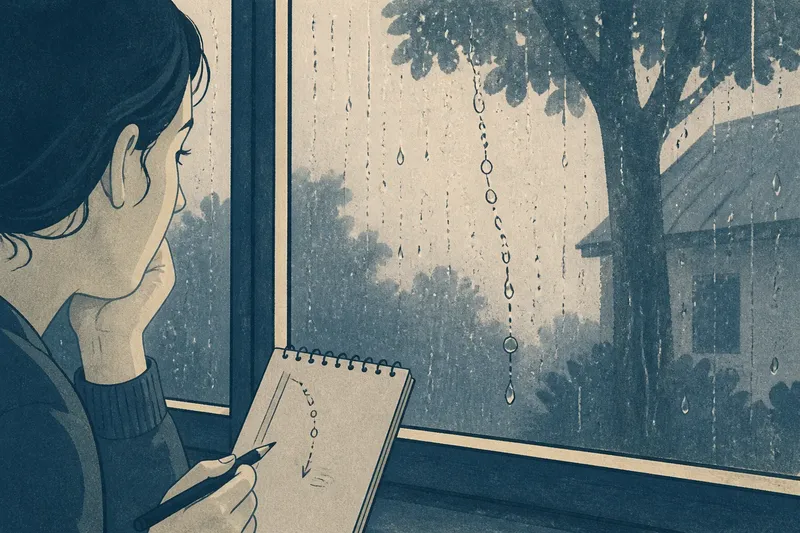
Choose one small patch of glass and follow a single bead. A window frame, muntin, or distant roofline gives your eyes a fixed reference. You need no special equipment; a scrap of paper or a notes app can help if you want to remember what happened.
Follow one drop across a fixed patch
A whole window invites your attention to wander. Pick a moving drop near a frame edge, then keep your gaze on it. Notice whether it leaves a thin wet track, slows at a speck, or merges with a neighbor and continues as a larger bead.
Describe only what you can see. “The lower drop joined the one above it and moved farther down” is a clear observation. “A hidden ridge pushed it aside” is a guess unless you can see that ridge.
If you want a record, sketch the frame edge first, then mark the drop’s starting position and where it ends up. A phone photo may capture the broad pattern, but reflections or camera focus can hide tiny beads. For following one drop, your eyes may do the better job.
Use the background to make fine rain visible
Fine rain may coat the pane in a soft film instead of forming distinct beads. A bright patch of sky can make that haze harder to read. Look instead toward a steady, darker background outside, such as a shaded wall or tree trunk.
Keep watching the same patch. If no single drop stands out, follow the border between wetter and less-wet glass. That edge can shift or branch even when individual beads are too small to separate.
A screen can add a mesh pattern to the view. If possible, look through a clearer section without pressing your face to the pane. Repeatedly changing position can introduce reflections and make the scene harder to compare.
Separate droplets from reflections
An indoor lamp, bright phone screen, or pale shirt can appear as a reflection. Reflected shapes may seem to move when you move your head; a drop remains attached to the glass. Settle in one position before following a bead.
If a nearby lamp is causing glare, turn it off when convenient. You can also sit where the room behind you is dimmer than the outdoor view. A dark cloth held behind your shoulder may soften a reflection, but keep the window clear and your view unobstructed.
Choose one recognizable feature on the glass and one fixed landmark outside. If both seem to slide together as you shift your head, you may be seeing reflection or parallax rather than the drop’s path. Return to your original position and check again.
Read wet trails without inventing their history
Fresh drops often meet damp tracks left by earlier water. A bead may spread into a track, join another drop, or make a line look darker. The final trail can therefore reflect the movement of several beads, not one continuous journey.
Start with a clear point and watch a short stretch. Note a sudden change in a bead’s size, a narrow line behind it, or a darker section of track. These are visible details; the exact cause may remain hidden.
If several trails crowd together, move to a nearby, clearer patch. Or stay with the busy section and describe how streams converge. In either case, treat the result as a pattern on this pane, not a forecast or a map of rain falling through the air.
Notice pauses, turns, and quiet spells
A bead may slow, pause, or veer to one side. Tiny surface marks, residue, or existing wet tracks can affect movement, but you usually cannot identify the cause from indoors. Note the change without assigning it a story.
Wait a little before deciding that a drop has stopped. It may gather water, meet another bead, or resume along a neighboring track. If it stays still, compare it with another drop nearby; a difference between the two is a useful observation in its own right.
When the rain eases, look at what remains: a line of moisture, a stationary bead, or several joined trails. If the view no longer changes, end the watch. Stillness belongs to the scene, too.
What can a rainy window watch tell you?
Why do two raindrops merge?
When their wet edges meet, separate beads can become one larger bead. Watch for the point where they join and follow the combined drop afterward.
Why does one drop move while another stays still?
Conditions can vary across a pane: surface texture, moisture, and existing trails are not always the same. Nearby drops may behave differently, even when the specific cause is not visible.
Do trails show which way rain is falling?
Trails show how water moved across that particular pane, not the direction of rain in the air. Keep the movement on the glass separate from the weather outside.
Can drops on a window predict the weather?
A window watch describes visible water patterns; it cannot establish what the weather will do next. For a forecast, use a weather service rather than interpreting one pane.
Make the next observation easy to compare
Say you notice a bead near the left edge while rain is steady. You choose a dark tree trunk as the background, sketch the frame edge on scrap paper, and mark the bead’s starting position. You then watch it join a thin trail and continue downward. Your finished note records a merge and a direction of travel across the pane; it does not claim to explain the trail or predict the weather.
For a useful rainy window watch, keep the viewpoint steady and change one condition at a time. If glare obscures a drop, dim the room; if fine rain blends into the sky, choose a darker background; if trails crowd together, shift to a clearer patch. The window offers a small, specific view of water in motion, and careful attention is enough to read it without turning it into something it cannot tell you.